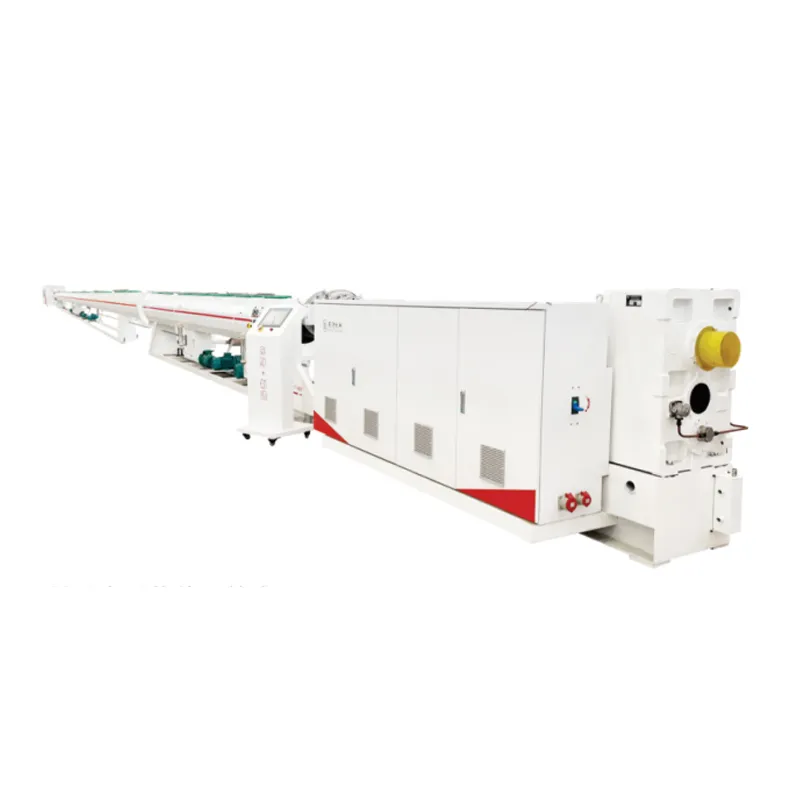
High Speed Extrusion Production Line For Pe Pp-r/pp-rt/pp-b Pipes
PE, PP-R/PP-RT/PE-B production lines are mechanical systems for manufacturing polyethylene (PE), polypropylene random copolymer (PP-R), polyethylene random copolymer reinforced pipe (PP-RT), and other related pipes. These pipes are used for irrigation, drainage, gas, and electricity in applications such as agricultural irrigation, building water supply and drainage, city gas, electricity, and industrial projects. The line enables a variety of pipe sizes with high automation and stable, reliable
Core Introduction
The high-speed extrusion production line equipment for PE, PP-R/PP-RT/PP-B pipes uses advanced technology, a high-end configuration, and a high-torque, low-noise reducer, fully reflecting high quality and performance.
1. Silo/Receiving Hopper: Used to store, transport, mix, and heat raw materials to ensure uniformity and proper material temperature.
2. Extruder: Heated plastic raw material is fed into the extruder. The screw conveys, melts, and homogenizes the material at high temperature, and then extrudes it through the die to form a tubular profile.
3. Die and Cooling System: The die design determines the pipe diameter and wall thickness. The cooling system rapidly cools and solidifies the molten plastic to achieve the required dimensions and physical properties.
4. Tractor: Pulls the thermoplastic pipe from the die to ensure uniform diameter and to maintain the required dimensions.
5. Cutting Machine: Cuts the pipe to the required length, and stacks the pipes using a conveyor system or an automatic system.
Science Popularization
The following provides a detailed introduction to PE, PP-R, PP-RT, and PP-B pipes:
1. PE Pipes
PE (polyethylene) is a family of resins produced through various processes, offering different structures, characteristics, and applications. PE pipes include medium-density polyethylene (MDPE) and high-density polyethylene (HDPE). They are categorized into SDR11 and SDR17 series based on wall thickness.
1. Performance Characteristics:
- Environmental protection and hygiene: During the processing of PE pipes, no heavy-metal salt stabilizers are added. The material is non-toxic, has no scaling layer, and does not promote bacterial growth, effectively addressing the problem of secondary pollution in municipal drinking water.
- Corrosion resistance: Except for a few strong oxidizers, PE pipes resist corrosion from various chemical media without electrochemical corrosion.
- Long service life: PE pipes can be used safely for more than 50 years under rated temperature and pressure conditions.
- Reliable jointing: The welding process is simple. The unique hot-melt butt welding technology ensures joint safety and reliability because the joint strength is higher than that of the pipe body.
- Good flexibility: High impact strength, high elongation at break, and strong resistance to earthquakes and deformation make it suitable for areas with frequent ground movement.
- Strong cold resistance: No physical changes occur at -20 °C, making it suitable for cold regions.
2. PP-R Pipes
PP-R pipe (also known as type III polypropylene pipe) is a new plastic pipe product developed and applied in Europe in the early 1990s. It is made from random copolymer polypropylene using extrusion and injection molding.
Performance Characteristics:
- Non-toxic and hygienic: The PP-R molecular structure consists only of carbon and hydrogen, with no harmful or toxic elements. It is hygienic and reliable and can be used in pure drinking water systems.
- Thermal insulation and energy saving: The thermal conductivity of PP-R pipe is low—only 1/200 of that of steel pipe.
- Long service life: Under working temperature conditions of 70 °C and working pressure of 1.0 MPa, the service life can reach more than 50 years. At room temperature, the service life can reach more than 100 years.
- Convenient installation: PP-R has good welding performance. Pipes and fittings can be connected using hot-melt or electric-melt methods, making installation convenient and ensuring joint reliability.
3. PP-RT Pipes
PP-RT (heat-resistant polyethylene) is a type of non-crosslinked polyethylene that can be used for hot water pipes.
1. Performance Characteristics:
- Lightweight and easy to transport, install, and construct.
- Good flexibility: During installation, the pipe can be coiled and bent, reducing the usage of pipe fittings and lowering construction costs.
- Environmental protection, non-toxic, tasteless, and good sanitary performance.
- Good low-temperature resistance, allowing use in winter under low-temperature conditions.
- Good chemical resistance, no rust, and long service life.
Fourth, PP-B Pipe
PP-B (polybutylene) pipe is also a type of plastic pipe. It has some properties similar to PP-R, such as non-toxicity, corrosion resistance, and light weight. However, due to differences in production processes and raw materials, its specific performance characteristics and application fields may vary.
Model DCS63 DCS110 DCS160 DCS250
Pipe diameter 20-63 20-110 40-160 50-250
Host model 60/38 60/40 60/40 75/38
Production capacity 200-400 300-500 400-500 500-650
Main motor power 90 110 110 160
 English
 Arabic
 Dutch
 French
 German
 Italian
 Japanese
 Korean
 Russian
 Spanish