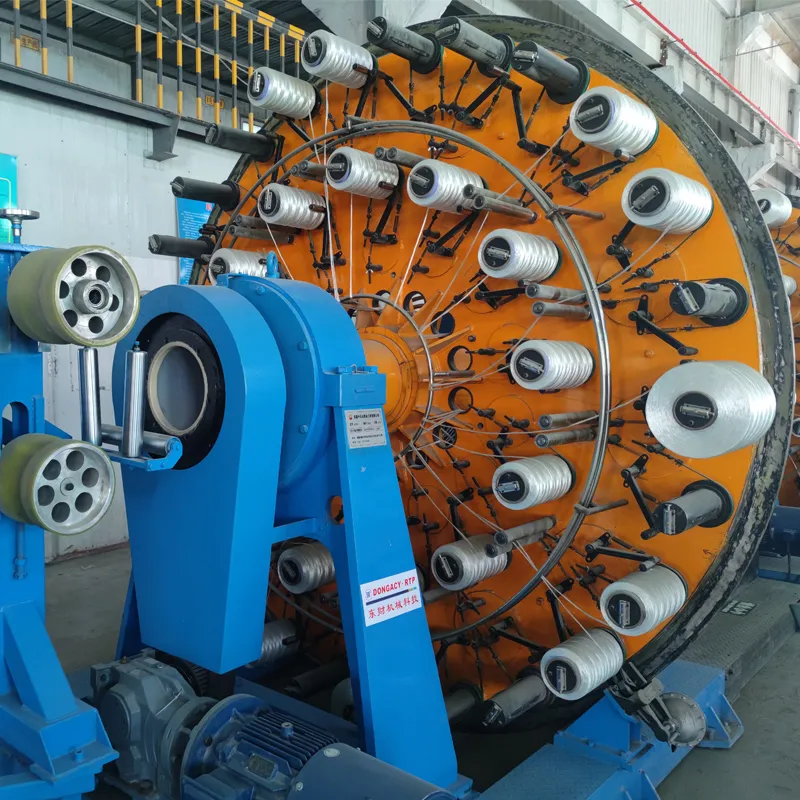
Fiber Filament Reinforced Rtp Polyethylene Composite Pipe Production Line
The thermoplastic composite pipeline used in this equipment provides reliable pressure resistance for transporting oil, natural gas, water, and for applications in the chemical industry and other high-pressure fields. It is supported by a dedicated production line— a specialized system for manufacturing fiber-reinforced RTP polyethylene composite pipes.
Production Line Composition
The production line for fiber-reinforced RTP polyethylene composite pipes mainly consists of a raw material supply system, an extrusion system, a fiber winding system, a composite molding system, a cooling and sizing system, and a cutting and packaging system.
Working Principle
Raw material supply: The system supplies raw materials such as polyethylene pellets and fiber filaments (e.g., aramid fiber and glass fiber).
Extrusion molding: After the polyethylene pellets are melted in an extruder, they are extruded into a tube.
Filament winding: Around the molten polyethylene pipe, fiber filaments are wound in a predetermined arrangement to form the reinforced layer.
Composite molding: Using a defined process, the reinforced fiber layer is closely bonded to the polyethylene pipe to form the composite pipe.
Cooling and shaping: The composite pipe is cooled and sized to ensure dimensional stability and maintain the required shape.
Cutting and packaging: The cooled composite pipe is cut to the required length and packed for shipment.
Product Features
Highlight 1 – High strength: The addition of fiber filaments significantly improves the composite pipe’s compressive, bending, and tensile performance.
Highlight 2 – Corrosion resistance: Polyethylene offers excellent corrosion resistance and can withstand the effects of various chemical media.
Highlight 3 – Good flexibility: While maintaining high strength, the composite pipe retains a degree of flexibility, enabling it to adapt to complex terrains and installation environments.
Highlight 4 – Long service life: By using high-quality raw materials and advanced production technology, the composite pipe delivers a longer service life.
Application Areas
Fiber-reinforced RTP polyethylene composite pipes are widely used in the petroleum, natural gas, chemical industry, water treatment, and related fields. In the oil and gas industry, RTP is used to transport oil and gas, water, and chemicals. In the chemical industry, RTP is used to transport corrosive media and high-temperature media. In water treatment applications, RTP is used in water supply and drainage systems.
Key Advantages
The fiber-reinforced RTP polyethylene composite pipe production line is an efficient and advanced manufacturing solution that produces composite pipes with excellent performance and supports application requirements in a wide range of complex environments.
 English
 Arabic
 Dutch
 French
 German
 Italian
 Japanese
 Korean
 Russian
 Spanish